 award of merit
jenn.heitzmann@bridgeim.com
Most environmental campaigns don't struggle with awareness. People know they should recycle more, use less water, and reduce waste.
The problem is getting them to do it.
For the Texas Commission on Environmental Quality, the goal wasn't just to inform Texans, but to help them take action in ways that felt realistic. Because no matter how important the message is, it won't stick if it feels complicated, inconvenient, or disconnected from how people live.
So instead of asking people to think bigger, we focused on making it easier to start smaller.
The 2025 Take Care of Texas campaign was built around a simple idea: if you can show people how to take small, practical steps, they're far more likely to follow through. Taking the pledge is a free, voluntary commitment to preserve Texas through everyday actions that conserve water and energy and keep the air clean, and it's the ultimate conversion because it means more conservation efforts are adding up to make meaningful change for the Lone Star State.
From the beginning, everything was designed to be participatory.
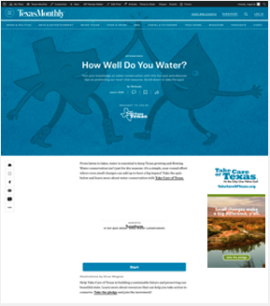
The Water Conservation Quiz didn't just list tips, it invited people to test their knowledge and learn something new. More than 19,700 Texans completed it, with over 2,500 opting in as new pledges, turning what could have been passive information into something interactive and memorable.
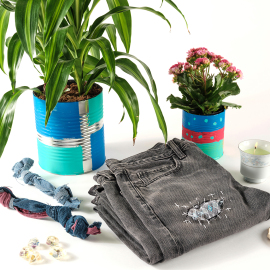
The DIY Gift Guide showed people how to reduce waste through step-by-step projects that turned recycled materials into gifts. It generated over 9,000 pageviews and more than 1,100 new pledges, proving that when sustainability is tangible, people respond.
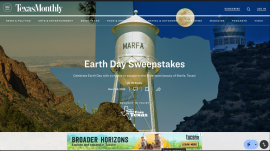
For Earth Day, we added a statewide sweepstakes to give people another reason to engage. That effort drove over 11,000 entries, with 5,100 people taking the pledge, a 45% opt-in rate, making it one of the program's most effective conversion drivers.
Just as important were the people behind the message.
Through a series of educator ambassador videos, teachers shared how they bring conservation into their classrooms. These stories made the campaign feel real. Instead of hearing from an institution, audiences saw how small habits could show up in daily life and how those habits can be passed on.
Across everything, the message was the same: small actions add up.
And people responded.
The campaign delivered over 16.9 million impressions and more than 160,000 clicks, driving sustained engagement across the state.
But the most meaningful result wasn't reach, it was action.
The campaign generated more than 12,500 new pledges, an increase of 196% year over year, dramatically exceeding program goals and demonstrating real behavior change at scale.
The impact also showed up beyond campaign metrics. As the client noted, the program has seen consistent growth and a significant increase in Texans pledging to take action, reinforcing that these efforts drive lasting change.
When people see sustainability as something they can do, not just something they're told to care about, it becomes part of their routine.
And that's when real change happens.