 category finalist
pr@creativ.com
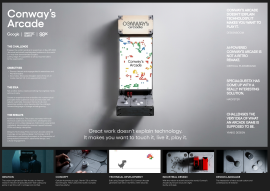
What if the best way to understand the most complex systems in the world wasn't to explain them, but to play with them?
Our strategy was to solve the problem of AI accessibility through a single, powerful insight: The best way to show AI is to make it interactive, physical, and intuitive. Instead of selecting from a library of pre-made games, we used Gemini 3.0 to create a gaming system that generates both the visual content and the underlying rules in real time. We reframed the problem of technical engagement by paying homage to John Conway’s "Game of Life," using mathematical principles that fascinate PhD-level researchers to create infinite gameplay variations.
Most AI is presented through abstract interfaces or passive demos that feel detached from the user. To connect with the world’s elite researchers at NeurIPS 2025, we realized we needed to move beyond the "black box" of AI. We chose to ground the experience in cellular automata, a foundational concept in computer science, and turn it into a breakthrough, playable system, a physical gaming arcade powered by Google Deepmind.
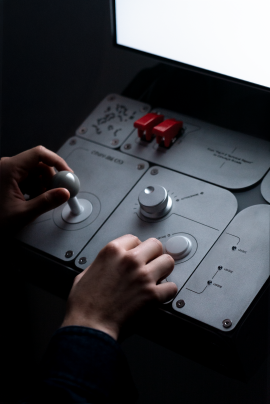
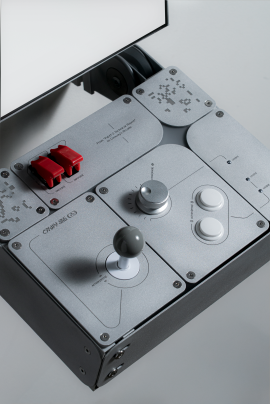
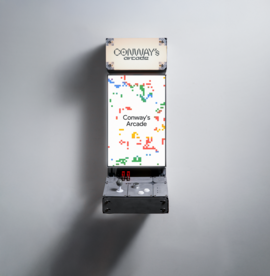
The work is a "live computational artifact" where code, interaction, and material constraints inform one another. We didn’t just build software; we designed a physical vessel for it. The machine is a custom-fabricated, modular structure produced in aluminum, bridge-building the gap between workshop-scale fabrication and laboratory experimentation. Inside this familiar arcade form, players use prompts to instantly generate and play games like Snake or Asteroids, each operating on adaptive, non-static logic.
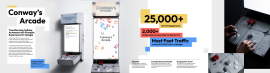
At NeurIPS, the arcade shifted the narrative from observation to active participation. What started as an R&D initiative at SpecialGuestX became the centerpiece of Google’s booth, proving that hands-on engagement drives longer dwell times and repeat play compared to traditional presentations. The project resonated globally, earning features in outlets like designboom for its ability to make complex ideas feel simple.
Conway’s Arcade is more than a single execution; it is a creative platform that demonstrates how technology companies can connect with technical audiences through shared cultural touchstones and curiosity. It moves the industry from static design toward living systems, where the user is an integral part of the creative process. It proves that when you make computational theory tangible, you don't just create a demo, you create a memory.